E-Invoice Relaxation Until 2027: What Phase 4 Businesses Can and Can't Do
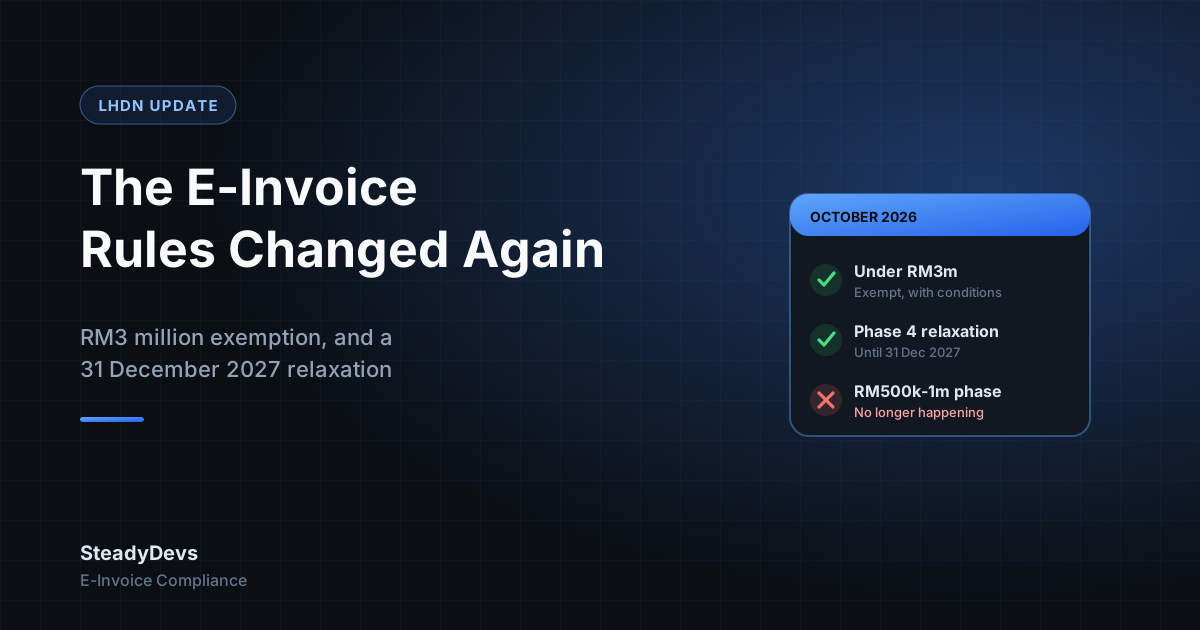
If your business turns over up to RM5 million and you're not exempt, you're in Phase 4 of Malaysia's e-invoice mandate. Your implementation date was 1 January 2026, or 1 July 2026 for some, and you now have an interim relaxation period until 31 December 2027.
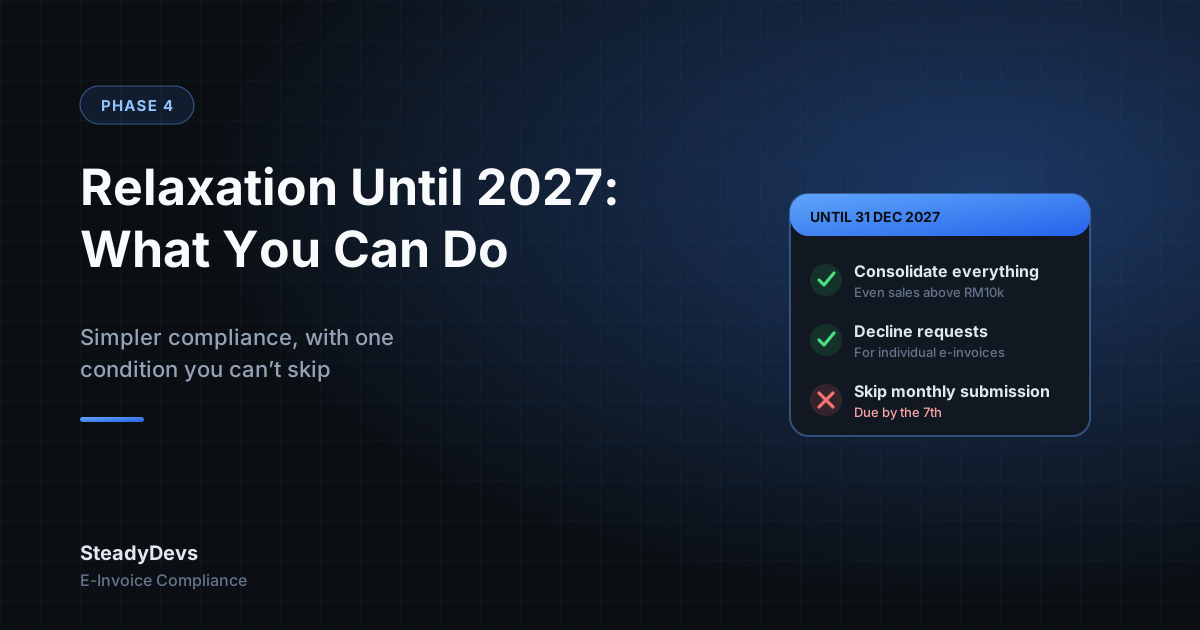
The relaxation is often described as a grace period, which makes it sound like nothing is required yet. That's not quite right. It's a simpler way to comply, with one condition you can't skip.
Sources: LHDN's e-Invoice implementation timeline (updated 30 August 2026), the e-Invoice Specific Guideline v4.9 (7 September 2026) and the e-Invoice FAQ (4 September 2026). This is a plain-language summary, not tax advice; confirm your own position with your tax agent.
What the Relaxation Allows
Section 16.2 of LHDN's e-Invoice Specific Guideline lets taxpayers in the relaxation period:
- Issue consolidated e-invoices for all activities and transactions, including the industries and transaction types normally barred from consolidation, such as single sales above RM10,000.
- Issue consolidated self-billed e-invoices for every self-billing situation.
- Put any description in the "Description of Product or Service" field, instead of the receipt or bill reference numbers normally required.
- Decline a request for an individual e-invoice from a buyer, or an individual self-billed e-invoice from a supplier, as long as consolidated e-invoices are issued.
In return, section 16.3 says LHDN won't prosecute under section 120 of the Income Tax Act for non-compliance with e-invoice requirements during the relaxation, provided you issue those consolidated e-invoices.
What It Still Requires
- Monthly submission. LHDN's FAQ is explicit: consolidated e-invoices must be issued monthly, following the normal timing rules for consolidation, not once at the end of the period.
- All your transactions, every month. If you later find transactions left out of a consolidated e-invoice, you need to correct it. The FAQ points to the voluntary disclosure programme for this.
- Correct submissions. A consolidated e-invoice still has to pass MyInvois validation.
Consolidated e-invoices for a month are normally due within seven days after the month ends. Treat the 7th as a fixed monthly deadline in your calendar or your system.
What You Don't Have to Do
- Share consolidated e-invoices with buyers. The FAQ says validated consolidated e-invoices don't need to be shared with buyers, and consolidated self-billed ones don't need to be shared with suppliers.
- List receipt numbers in the description field.
You Can Choose Not to Use It
The relaxation is for businesses whose systems aren't ready yet. LHDN's FAQ confirms that if your system can already issue individual e-invoices for each transaction, you may follow the full rules instead. Many businesses selling to larger customers will want to, because those customers need individual e-invoices to support their own expenses.
How to Use the Time Well
- Now: make sure a monthly consolidated e-invoice goes out by the 7th, every month. This is what keeps you inside the no-prosecution condition.
- Early 2027: get your POS, accounting or invoicing system producing the data MyInvois needs per transaction: buyer TIN and identification, classification codes and tax details.
- Mid 2027: run transaction-level e-invoicing in parallel and fix rejections while mistakes are cheap.
- By December 2027: switch over fully, so 1 January 2028 is a normal working day.
Running an Older System That Can't Talk to MyInvois?
We connect legacy .NET, SQL Server and custom POS systems to MyInvois without a rebuild. Get an honest view of what your system needs and what it costs.
Talk to UsThe Bottom Line
The relaxation buys Phase 4 businesses more than a year, and it makes compliance much simpler in the meantime. But it only protects businesses that keep submitting monthly consolidated e-invoices, and from 1 January 2028 the full rules apply. Use 2027 to get ready, not to wait.
Frequently Asked Questions
No. LHDN's FAQ says consolidated e-invoices must be issued monthly during the relaxation. The no-prosecution condition depends on issuing them.
During the relaxation, section 16.2(d) lets you decline, provided you issue consolidated e-invoices. You may still choose to issue one if your system can.
Section 16.2(a) allows consolidated e-invoices for all transactions, including those normally excluded under section 3.7, which is where the rule on single transactions above RM10,000 sits. It applies again from 1 January 2028.
LHDN's FAQ suggests either a credit note and a new, complete consolidated e-invoice for that period, or a separate consolidated e-invoice for the omitted transactions, through the voluntary disclosure programme.