Under RM3 Million but Not Exempt: The E-Invoice Rule Catching Small Companies Out
When LHDN raised the e-invoice exemption to RM3 million, a lot of small business owners relaxed. If you turn over less than that, the reasoning goes, e-invoicing isn't your problem.
For many businesses that's right. But the exemption comes with conditions, and they're exactly the conditions that apply to small companies that are part of a larger group. If yours is one of them, you may have been required to e-invoice since 1 July 2026.
Sources: LHDN's e-Invoice implementation timeline (updated 30 August 2026), the e-Invoice Specific Guideline v4.9 (7 September 2026) and the e-Invoice FAQ (4 September 2026). This is a plain-language summary, not tax advice; confirm your own position with your tax agent.
The Three Conditions That Cancel the Exemption
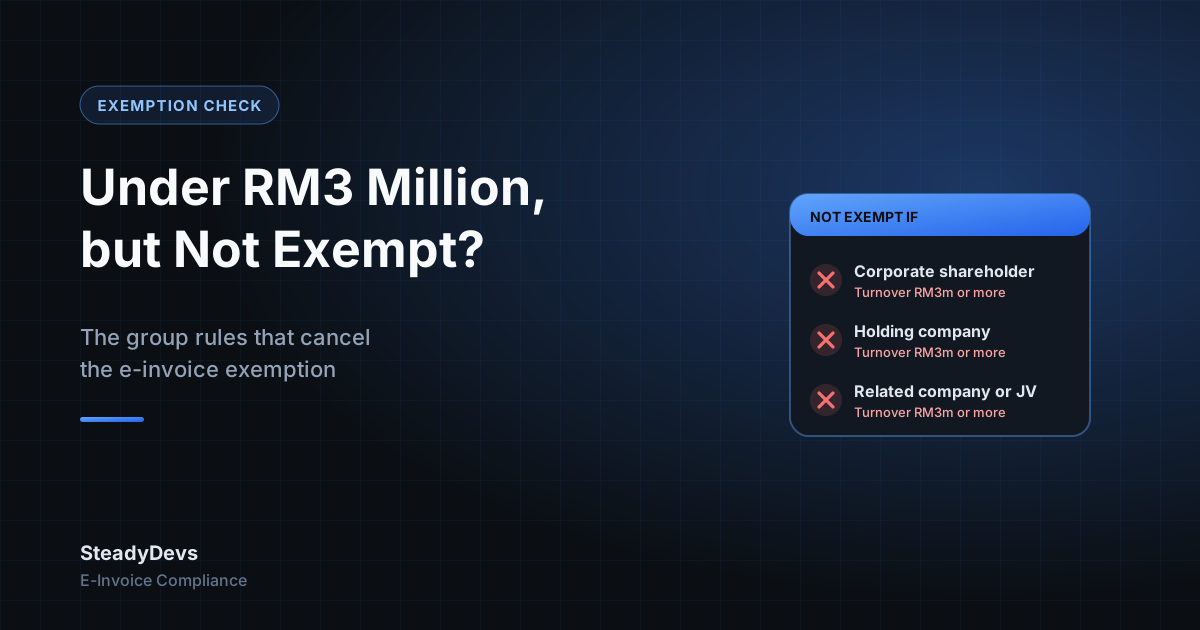
According to LHDN's FAQ, the RM3 million exemption does not apply to a taxpayer that:
- Has a non-individual shareholder with turnover of at least RM3 million. If a company, rather than a person, owns shares in your business and that company turns over RM3 million or more, you don't qualify.
- Is a subsidiary of a holding company with turnover of at least RM3 million.
- Has a related company or joint venture with turnover of at least RM3 million. "Related company" follows the definition in the Promotion of Investments Act 1986.
LHDN's own example makes the point. A subsidiary with RM400,000 in annual revenue doesn't qualify, because its parent is required to e-invoice. It must implement from 1 July 2026, the concessionary implementation date.
Who This Usually Catches
- Small operating companies inside a family group, where a larger trading or holding company owns the shares.
- New ventures set up by an established business, such as a second brand, outlet or service arm.
- Joint ventures where one partner is a substantial company.
- Franchise or distribution companies owned by, or related to, a larger principal.
A quick test: look at your company's shareholder register. If any shareholder is a company rather than a person, check that company's turnover before assuming you're exempt. Or check your situation in three questions.
How Turnover Is Measured
LHDN uses the turnover or revenue in the statement of comprehensive income of your audited financial statements. If you don't have audited accounts, it uses the revenue declared in your tax return for the relevant year of assessment.
If You Grow Past RM3 Million
An exempt business that later reaches RM3 million must implement from 1 January of the second year after the year of assessment in which it crossed the threshold. LHDN's example is a company that passed RM3 million in 2026 and must start on 1 January 2028. That's useful notice, but only if someone is watching the number.
If You've Discovered You Weren't Exempt
Don't panic, and don't ignore it. If you fall within Phase 4, the interim relaxation until 31 December 2027 lets you issue monthly consolidated e-invoices for all transactions. Past months you missed can be regularised through the e-Invoice Special Voluntary Disclosure Programme, which runs until 31 December 2027 and needs no registration.
- Confirm your status with your tax agent, using your group structure, not just your own revenue.
- Start issuing monthly consolidated e-invoices from the current month.
- Use the SVDP to submit the months you missed, one consolidated e-invoice per month.
- Plan for transaction-level e-invoicing before 1 January 2028.
Want E-Invoicing Handled Without the Guesswork?
Our MyInvois platform validates every invoice against LHDN's rules before submission, consolidates monthly, and warns you before the 7th-of-the-month cut-off. From RM29/month, no contract, and you can export all your data any time.
See the E-Invoice PlatformFrequently Asked Questions
Generally yes. The group conditions are about corporate shareholders, holding companies and related companies, which a sole proprietorship usually doesn't have. LHDN's FAQ uses a sole proprietor below RM3 million as its example of an exempt business.
The condition refers to non-individual shareholders, meaning companies and similar entities. Individual shareholders don't remove the exemption under that rule.
Yes. Voluntary adoption is allowed, and it's often the practical answer when larger customers need validated e-invoices for their own records.